
Showing posts with label Bio. Show all posts
Showing posts with label Bio. Show all posts
Monday, April 15, 2013
Lung Models
As we study the respiratory system, the movement of the diaphragm can be confusing for students. This year, I decided to make a model with them using a cup, balloons, and straws. We built the models together and they worked in pairs to determine which organ was represented by each part of the model. After the models were labeled, I taught students how to use them. Each time your diaphragm contracts, it gives your lungs more space to expand and fill with air. This can be seen as you pull the stretched balloon down and the lungs fill up with air. These models gave students a visual to help them understand how the diaphragm works. Next time I make these models with students, I will try to plug the top opening with clay. In some models, the cut at the top of the cup was too large so the lungs did not fill up with enough air to clearly see it.

Life of an Oxygen Molecule
This year I have a really great group of writers. Many of them love creative writing especially when they can incorporate dialogue! I try to take advantage of this whenever I can. As we studied the respiratory system in science, we talked about how oxygen moves through your body and how the respiratory system works closely with circulatory system. To assess their understanding, student personified an oxygen molecule and wrote a short story about its journey through the body. I gave them a list of words that must be included to help guide their story.
Illinois State Learning Standards:
12.A.4b. Describe the structures and organization of cells and tissues that underlie basic life functions including nutrition, respiration, cellular transport, biosynthesis, and reproduction.

Illinois State Learning Standards:
12.A.4b. Describe the structures and organization of cells and tissues that underlie basic life functions including nutrition, respiration, cellular transport, biosynthesis, and reproduction.
Thursday, March 28, 2013
The Heart and Blood Flow
Personally, I think understanding the flow of blood can be very challenging for students especially when they are just learning the parts of the heart. To introduce the parts of the heart, I create a bulletin board display in my classroom. Students label the parts of the heart with a wet erase marker. Then we use the diagram to draw arrows that indicate the pathway of blood flow. We also add facts about each side of the heart. I like using the bulletin board because students can always look and refer to it.
Illinois State Standards:
12.A.4b. Describe the structures and organization of cells and tissues that underlie basic life functions including nutrition, respiration, cellular transport, biosynthesis, and reproduction.

Illinois State Standards:
12.A.4b. Describe the structures and organization of cells and tissues that underlie basic life functions including nutrition, respiration, cellular transport, biosynthesis, and reproduction.
Thursday, December 27, 2012
Skin Brochure
To wrap up our unit about the skin, students created a skin brochure that could be used in a dermatologist's office. The brochure would provide information about the layers of the skin, functions, of skin, and of course, the risk of skin cancer.
Thanks to the computer teacher, students were able to use Publisher to make their brochures fancy and professional!


Thanks to the computer teacher, students were able to use Publisher to make their brochures fancy and professional!
Illinois State Standards:
12.A.3a Explain how cells function as “building
blocks” of organisms and describe the requirements for cells to live.
Objectives:
Students will:
-create a visually appealing brochure
-identify the layers of skin
-list the functions of the skin
-explain the risk of skin cancer
Assessment:
Students were assessed based on the completeness and accuracy of their brochure using the following rubric:
Sunday, November 11, 2012
Muscular System Project
To wrap up our muscular system unit, I am having students create an advertisement for an imaginary workout facility/workout program. Last year I did this project, but the students worked on it individually and made brochures in computer class. This year I decided to have them work with a partner and create a poster. I did this because I am really working on having my students work together. Although I have no serious problems between students that disrupt the classroom environment, I do notice there are cliques within my classroom. Despite the cliques, I want students to be able to work together and respect the opinions of their peers.

Students were assessed based on their final product. Students had to follow the directions correctly and include accurate information. The creativity and neatness of the poster was also assessed. Students' ability to work together was informally assessed and monitored as they worked during class.
 |
| This one cracks me up with the before and after pictures. If you can't tell, they pasted their faces to the after pictures :) |
Illinois State Standards:
12.A.3c. Compare and contrast how
different forms and structures reflect different funtions (e.g., similarities
and differences among animals that fly, walk, or swim; structures of plant
cells and animal cells).
Objectives:
Students will:
-create an advertisement to promote muscle fitness
-explain how their workout program benefits muscles
-define vocabulary such as aerobic, anaerobic, flexibility, strength, and endurance
-identify specific muscles that are used specific exercises
-work with peers and develop respect for opinions that may be different from their own
Assessment:
Students were assessed based on their final product. Students had to follow the directions correctly and include accurate information. The creativity and neatness of the poster was also assessed. Students' ability to work together was informally assessed and monitored as they worked during class.
Chicken Wing Dissection
Seventh grade had their first dissection experience. They each had the opportunity to dissect a chicken wing. Before the dissection, there were many mixed feelings. Some were very excited while others were quite nervous. After their initial fear, the students were engaged and interested. Even though they are simply chicken wings from the grocery store, it is a great way for students to see how the muscular system and skeletal system work together. It is fun to watch the students explore and see their surprise when they realize this is the same chicken they eat at home. So many of them have no idea they eat muscles of animals.

 Students were assessed based on their recorded observations as well as their ability to point and verbally identify each part of the chicken wing.
Illinois State Standards:
12.A.3c. Compare and contrast how
different forms and structures reflect different funtions (e.g., similarities
and differences among animals that fly, walk, or swim; structures of plant
cells and animal cells).
Objectives:
Students will:
-identify and describe the muscles, bones, ligaments, tendons, and cartilage of a chicken wing
-explain how the skeletal system and muscular system work together
-compare and contrast the human arm with the chicken wing
Assessment:
Students were assessed based on their recorded observations as well as their ability to point and verbally identify each part of the chicken wing.Bone Observations
During our study of the skeletal system, students had the opportunity to observe dried pig ribs and a beef marrow bone. This allows students to see each part of the bone rather than simply looking at a picture in their textbooks.
Illinois State Standards:
12.A.3c. Compare and contrast how
different forms and structures reflect different funtions (e.g., similarities
and differences among animals that fly, walk, or swim; structures of plant
cells and animal cells).
Objectives:
Students will:
-identify and describe compact bone, spongy bone, bone marrow, and the outer covering
-explain the functions of each part of the bone
Assessment:
Students were assessed based their observation charts and their ability to point out and verbally identify parts of the bone.
Skeletal System Concept Maps

To wrap up our unit of the skeletal system, I
teamed up with the computer teacher to help my students make concept maps of
skeletal system vocabulary. I like this project because it allows
students to see how all parts of the skeletal system are connected and makes a
good study guide for the chapter test. Furthermore, it allows students to
gain experience with concept maps while providing them with the opportunity to
be creative.
Skeletal System Concept Map Assignment
Skeletal System Concept Map Assignment
Illinois State Standards:
 12.A.3c. Compare and contrast how
different forms and structures reflect different funtions (e.g., similarities
and differences among animals that fly, walk, or swim; structures of plant
cells and animal cells).
12.A.3c. Compare and contrast how
different forms and structures reflect different funtions (e.g., similarities
and differences among animals that fly, walk, or swim; structures of plant
cells and animal cells).
Objectives:
Students will:
-create a concept map using skeletal system terms
-explain how parts of the skeletal system are
dependent on each other
-create a useful study tool
Assessment:
Students were assessed based on
whether or not they included all the required vocabulary. Furthermore, I
also evaluated how they connected each of the terms and the examples they
provided. The computer teacher also assessed students' concept maps for a
computer grade.
Tuesday, October 9, 2012
Plant Growth Experiments
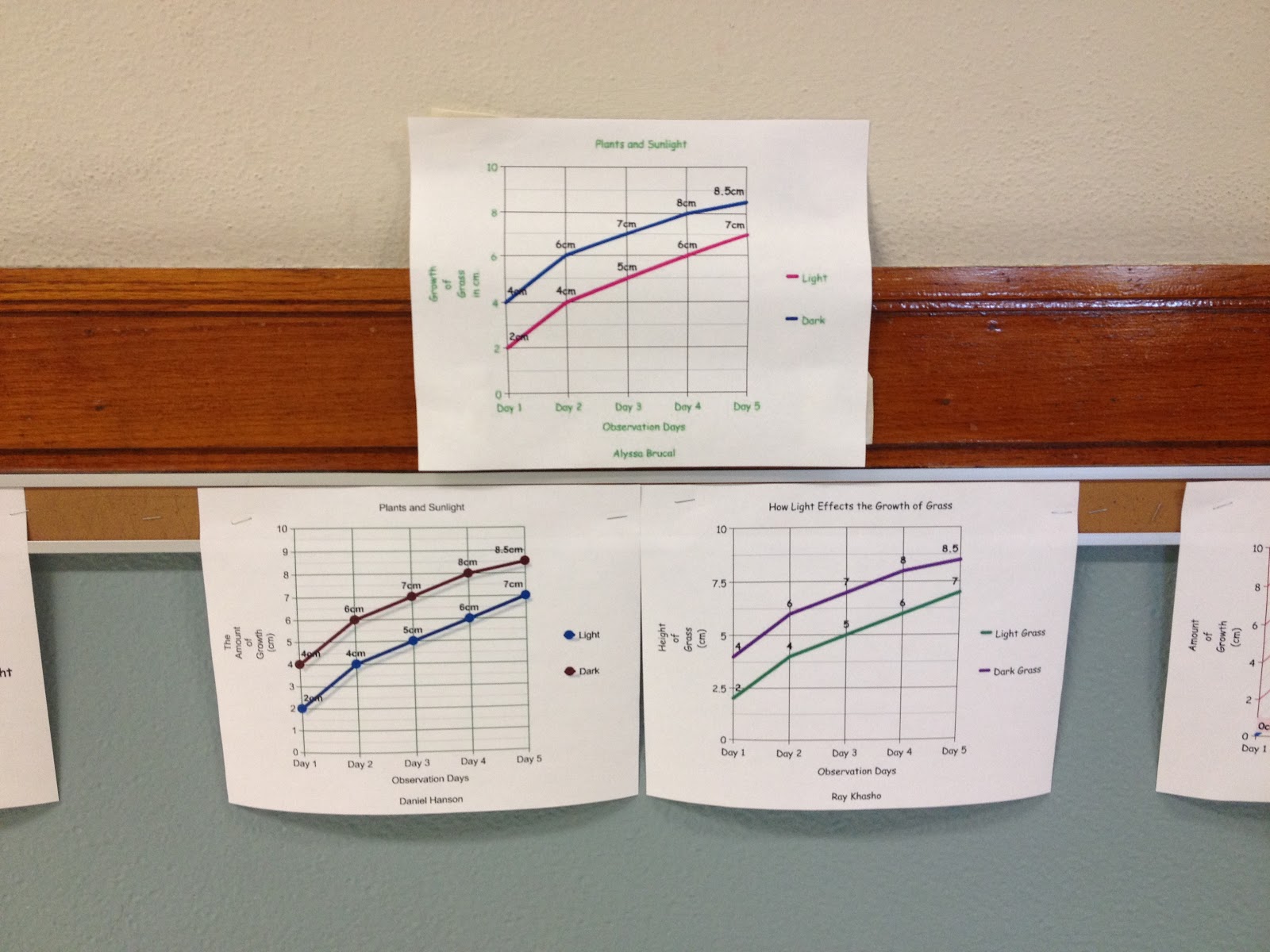
In our study of plants, seventh graders designed experiments to see how plant growth is affected by light and water. Students worked in groups to carry out the scientific method. One group tested how different amounts of water affect plant growth while the other groups experimented with the amount of light plant receive.
Illinois State Standards:
 Students were assessed on a lab report that outlined each step of the scientific method. A rubric was used in the grading process.
Illinois State Standards:
11.A.3a Formulate hypotheses that can be tested by collecting data.
11.A.3b Conduct scientific experiments that control all but one
variable.
11.A.3c Collect and record data accurately using consistent
measuring and recording techniques and media.
11.A.3d Explain the existence of unexpected results in a data set.
11.A.3g Report and display the process and results of a scientific
investigation.
Objectives:
Students will:
-collaborate with peers to carry out the scientific method
-design an experiment to determine how plant growth is affected by varied amounts of light and water
-create appropriate data tables and graphs to display results
Assessment:
Students were assessed on a lab report that outlined each step of the scientific method. A rubric was used in the grading process.Friday, August 31, 2012
Plant Cells
Seventh grade science begins with the study of ecosystems. So right now were focusing on plant cells. Of course, I want students to know the parts of the plant cell and their functions. Our book is pretty old and does not go into as much detail as I would like. So another teacher showed me the iCell iPad app which was great for what I wanted my students to accomplish. It provides 3D exploration of the plant cell and describes each structure and function. The app is available for iPhone, iPad, and even your computer. It also has three different levels of information. Basic was just enough for us. After exploring the app and taking notes, they created their own labeled plant cell. However, to spice up the old colored pencil drawing of the cell, they used the AutoShapes in MicrosoftWord. Here are some of the finish products.
Illinois State Standards:
12.A.3a Explain how cells function as “building blocks” of organisms and describe the requirements for cells to live.
12.A.3c Compare and contrast how different forms and structures reflect different functions (e.g., similarities and differences among animals that fly, walk or swim; structures of plant cells and animal cells).
Objectives:
-Students will:
-draw a plant cell using MicrosoftWord.
-label the structure of the cell
-recognize the difference between a plant and animal cell
Assessment:
 Students were assessed on the inclusion of all cell structures, appropriateness of chosen shapes, and chosen location of shapes. Along with this illustration, students also turned in notes after exploring iCell and took a quiz on plant cell structures and functions.
Illinois State Standards:
12.A.3a Explain how cells function as “building blocks” of organisms and describe the requirements for cells to live.
12.A.3c Compare and contrast how different forms and structures reflect different functions (e.g., similarities and differences among animals that fly, walk or swim; structures of plant cells and animal cells).
Objectives:
-Students will:
-draw a plant cell using MicrosoftWord.
-label the structure of the cell
-recognize the difference between a plant and animal cell
Assessment:


Subscribe to:
Posts (Atom)