Tuesday, October 9, 2012

Plant Growth Experiments

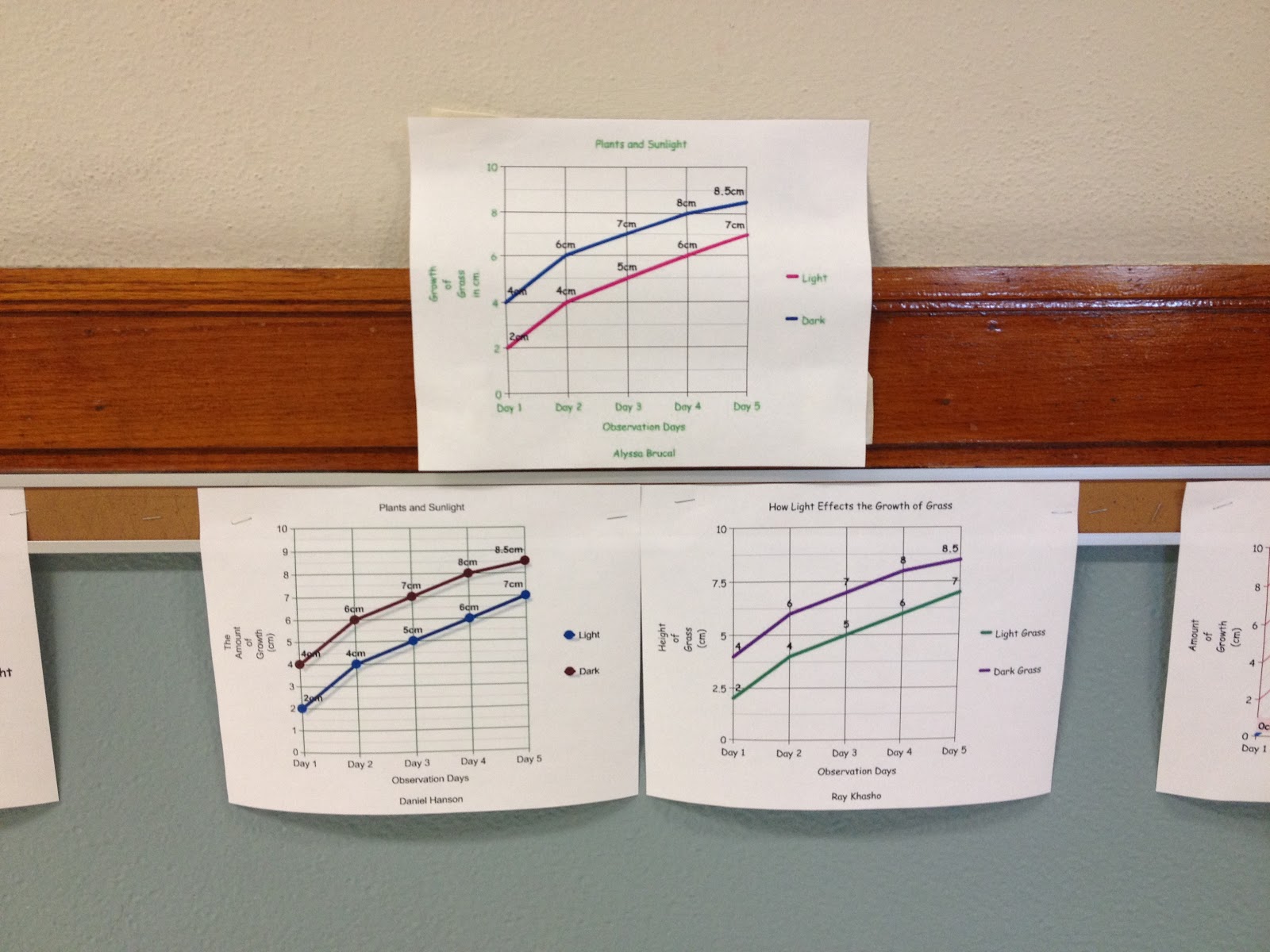
In our study of plants, seventh graders designed experiments to see how plant growth is affected by light and water.  Students worked in groups to carry out the scientific method.  One group tested how different amounts of water affect plant growth while the other groups experimented with the amount of light plant receive.

Illinois State Standards:

11.A.3a  Formulate hypotheses that can be tested by collecting data.
11.A.3b  Conduct scientific experiments that control all but one variable.
11.A.3c  Collect and record data accurately using consistent measuring and recording techniques and media.
11.A.3d  Explain the existence of unexpected results in a data set.
11.A.3g  Report and display the process and results of a scientific investigation.

Objectives:
Students will:
-collaborate with peers to carry out the scientific method
-design an experiment to determine how plant growth is affected by varied amounts of light and water
-create appropriate data tables and graphs to display results

Assessment:
 Students were assessed on a lab report that outlined each step of the scientific method.  A rubric was used in the grading process.
First Art Lesson

So this year, each classroom teacher is responsible for teaching art to their homeroom.  Although I knew this would be challenging at times, I was very excited for this chance to be creative and see my students' creativity.  Luckily, I found this helpful website: Art Lessons.  The first project I had my students work on were self portraits.  These were unique self portraits because half of them are realistic and the other half are abstract.  They used symbols that represent them to form the abstract side of their portrait.  This was definitely a challenging first project, especially for not having much art education background, but it was fun for both me and the students.  
Here are the final products!

Topographic Maps


The first chapter in sixth grade science discussed landforms, maps, and globes.  The most unfamiliar map for them was the topographic map.  We spend a great deal of time interpreting these maps, making our own keys, and understanding what information the map can provide.  To enforce the students' understanding, they created their own topographic maps.  I provided each group with a clay "landform", a pie pan covered in plastic wrap with a small opening to pour water, a beaker, and water.  Students placed their landform in the pie pan and poured water into the pan in intervals of 200mL.  Each time they they poured 200mL, they used a dry erase marker to trace the outline of the water around the clay landform.  As they continued to do this, they created multiple contour lines showing the  elevation of their landforms.  From there, student created a key for their map.  Here are some of the topographic maps.


Sunday, September 16, 2012

Google Docs

As I mentioned, my class was super excited to create a modern version of Romeo & Juliet.  I wanted to get this project moving along because it will definitely be time consuming.  So on Friday, I set up each student with a Gmail account introduced them to GoogleDocs.  They were new to this feature of Google, but were eager to learn.  After creating a document with their small groups, I told them that I wanted them to finalize their script by Monday.  After leaving the computer lab, I was still apprehensive of how successful this would be.  Well, it is now Sunday and all groups have their scripts done on GoogleDocs so I am very pleased.  I look forward to talking to them tomorrow and getting their feedback.  If they thought it was efficient, I will definitely be using it again this year!

Tuesday, September 11, 2012

Romeo & Juliet Modernized

As I mentioned, we began our year by reading a simplified version of Romeo and Juliet.  To say that my class loved it would be an understatement.  They could not get enough of it and asked if we could read more of Shakespeare's work.  Of course, this was a simplified version, but for them to have a positive outlook on Shakespeare makes me so happy!  Anyways after we finished reading it, we watched West Side Story and students were asked to compare and contrast the two as they watched the musical.  From there, we discussed how West Side Story was a modernized Romeo and Juliet.  I presented them with the project to make their own modernization of the story and act out a scene.  I knew they would be excited because last years class already told them how much they loved it, but they were beyond excited. After I presented the project to them, they asked if they could all work together to make an entire play.  I could not turn down their excitement and creativity.  So today we started our modern version of Romeo & Juliet.  It is going way smoother than I expected and their enthusiasm is so encouraging.  I LOVE MY CLASS!!

Sunday, September 9, 2012

Word Nerd

I am obsessed with breaking words apart to help myself and students understand their meaning and make connections to other words they know.  My first year of teaching I had a "Piecing Together Meaning" word wall with roots, prefixes, and suffixes.  This year, I took the same idea and spiced it up with a little bit more color and a few more examples.  This board was Pinterest inspired by these two fellow Pinners.
Root Word Foldable
Word Nerd Wall
Thanks for the inspiration!


Illinois State Standards:
4b.  Use common, grade-appropriate Greek or Latin affixes and roots as clues to the meaning of a word.

Objectives:
Students will:
-identify words with their assigned root
-define identified words and connect the definition back to the meaning of the root

Assessment: 
Students were assessed on the connections they made from the root's meaning the definition of their identified words.  Students were also quizzed on the roots.

Monday, September 3, 2012

Elizabethan Era Project

Last week, my class worked on a pre-reading project for Romeo & Juliet.  First, we talked about what they already knew (or thought they knew) about Romeo & Juliet.  Next, we focused on the setting and author.  We discussed the time period of Shakespeare's drama and life during that era.  From there, I gave them information about different social classes, occupations, and education.  Each student chose an occupation that interested them and was asked to write a classified ad that advertised the type of work they did.  Within the ad, they were required to discuss their education, experience, and request a wage.  Something the kids really got a kick out of was choosing their Elizabethan name.  I had them choose from a list of common names from the Elizabethan Era.  I found some great resources at kidsloveshakespeare.com.  After the students finished their rough drafts of their ads, we aged paper with coffee and tore the edges to make it look old.  Here are some of the finished products!


Illinois State Standards:
CC.7.R.L.3 Key Ideas and Details: Analyze how particular elements of a story or drama interact (e.g., how setting shapes the characters or plot).

Objectives:
Students will:
-describe an occupation of the Elizabethan era
-compare and contrast education of today with education of the Elizabethan era
-identify social classes of the Elizabethan era
-relate the information of their classified ad to the characters in Romeo & Juliet

Assessment: 
Students were assessed on the accuracy of their final product.  They were to include their Elizabethan name, education, experience, requested wage, and contact information as well as a picture.